
Why Stormwater Is Becoming the Biggest Risk for Secondary Dwellings in NSW
For many homeowners and small developers in NSW, secondary dwellings (granny flats) appear straightforward under the Housing SEPP pathway. The planning controls often focus on setbacks, floor area, landscaping, and private open space.
However, one issue is increasingly causing delays, redesigns, refusals, and expensive engineering upgrades:
Stormwater and Surface Water Management
This is especially critical on:
-
rear-falling sites,
-
low-lying land,
-
constrained suburban lots,
-
battle-axe blocks,
-
narrow sites,
-
and properties affected by overland flow paths.
In many cases, drainage feasibility becomes more important than the architectural design itself.
The Legislative Requirement
Exempt and complying development certificate – SEPP 2008
Clause 3.31 stated:
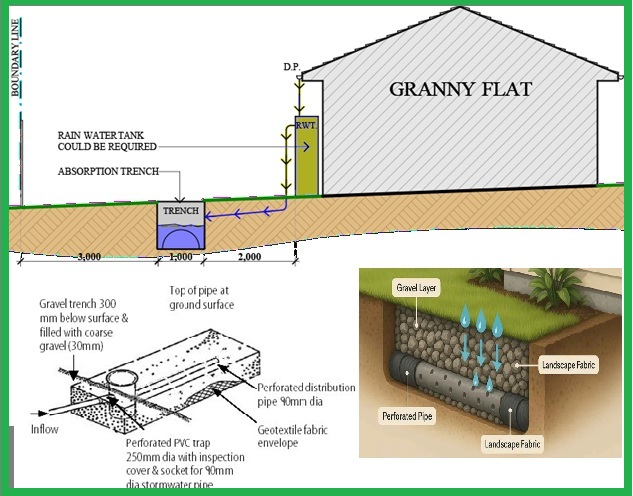
All stormwater collecting as a result of development under this code must be directed by a gravity fed or charged system to:
(a) a public drainage system, or
(b) an inter-allotment drainage system, or
(c) an on-site disposal system.
It also required compliance with:
-
Section 68 of the Local Government Act 1993, or
-
applicable stormwater requirements under the relevant Development Control Plan (DCP).
Housing SEPP 2021 Requirement
The requirement continues under the current legislation.
Housing SEPP 2021 – Clause 19 Drainage
The clause states:
All stormwater collecting as a result of development for the purposes of a secondary dwelling or an ancillary structure must be conveyed by a gravity fed or charged system to:
(a) a public drainage system,
(b) an inter-allotment drainage system, or
(c) an on-site disposal system.
Importantly, the clause also requires:
-
approval under Section 68 of the Local Government Act 1993 where applicable, or
-
compliance with council DCP stormwater requirements.
Why This Matters More Than Most People Realise
Many property owners assume:
-
“If I can fit the building, I can build it.”
But councils, certifiers, and engineers increasingly assess:
-
where stormwater goes,
-
how surface water behaves,
-
whether runoff increases flood risk,
-
and whether overland flow paths are obstructed.
This has become a major issue across NSW following increased scrutiny after recent flooding events.
The Biggest Problem: Rear-Falling Lots
A rear-falling site means the backyard sits lower than the street.
This creates serious drainage challenges because:
-
gravity discharge to the street may not be possible,
-
sewer invert levels may be too high,
-
stormwater may pond behind the dwelling,
-
and overland flow may concentrate at the rear boundary.
When a secondary dwelling is placed at the rear:
-
it can block natural surface flow paths,
-
reduce infiltration areas,
-
create nuisance flooding,
-
and transfer water impacts to neighbouring properties.
Common Non-Compliance Issues
1. No Legal Point of Discharge
A compliant drainage system requires lawful discharge to:
-
council stormwater,
-
an inter-allotment drainage easement,
-
or an approved on-site disposal system.
Many sites do not have one.
2. Reliance on Pump-Out Systems
Where gravity drainage is impossible, owners often propose:
-
charged lines,
-
pump pits,
-
or mechanical systems.
These may:
-
trigger additional approvals,
-
May not be compliant under some DCPs
-
increase maintenance obligations,
-
and concern certifiers or councils due to long-term reliability risks.
3. Overland Flow Path Obstruction
Secondary dwellings are frequently proposed in:
-
the exact area where stormwater naturally flows or existing stormwater absorption pit is located.
Blocking these paths can:
-
redirect water toward neighbouring properties,
-
increase flood depth,
-
or create liability issues.
4. Surface Water Is Different from Roof Water
Many applicants only assess roof drainage.
However, councils also examine:
-
sheet flow,
-
upstream runoff,
-
concentrated surface flow,
-
detention impacts,
-
and storm event behaviour across the entire site.
A roof drainage solution alone may still fail compliance, due to extensive land fall towards rear.
5. Section 68 Approval Requirements
Under the Local Government Act 1993, certain stormwater drainage works require approval under:
Section 68 – Part B
Including:
“Carry out stormwater drainage work”
This becomes particularly relevant where:
-
new drainage infrastructure is proposed,
-
connection to council systems is required,
-
easements are affected,
-
or engineered drainage systems are necessary.
Why Many CDC Proposals Fail Late
A common scenario:
The design satisfies:
-
setbacks,
-
floor area,
-
landscaping,
-
height,
-
and parking requirements.
But later fails because:
-
stormwater cannot drain lawfully,
-
surface water management is unresolved,
-
or hydraulic design is non-compliant.
-
there is no lawful stormwater discharge
At that stage:
-
redesign becomes expensive,
-
approval pathways change,
-
and construction feasibility may collapse.
What Homeowners Should Do Before Designing
Before committing to plans or construction contracts, obtain:
-
a contour survey,
-
stormwater concept design,
-
hydraulic advice,
-
and drainage feasibility assessment.
consider Extension and addition instead
or even avoid to propose secondary dwelling on some non-feasible lands
This should confirm:
-
lawful point of discharge,
-
existing easements,
-
invert levels,
-
overland flow paths,
-
detention requirements,
-
whether gravity drainage is achievable or pumped system is acceptable under the DCP
Key Warning Signs for Developers and Owners
Extra caution is needed where:
-
the site falls to the rear,
-
neighbouring land drains through the property,
-
there is evidence of ponding,
-
retaining walls exist,
-
easements are absent,
-
or the proposed dwelling occupies low points on site.
These are often indicators that stormwater compliance may become the defining approval issue.
Final Thought
In today’s NSW planning environment, stormwater management is no longer a secondary engineering detail.
For many secondary dwelling projects, it is the single issue that determines whether the development is:
-
compliant,
-
certifiable,
-
financially viable,
-
and legally defensible.
Before focusing on floor plans and finishes, homeowners and developers should first confirm one critical question: