
Tree Removal NSW: Approvals & $18K Fines
Tree Removal NSW: Approvals & $18K Fines
Understanding NSW tree protection regulations, Tree Protection Zones (TPZ), Structural Root Zones (SRZ), council approvals, construction requirements and penalties for unauthorised tree removal.
Trees are an important part of our urban environment. They provide shade, improve air quality, support biodiversity, reduce urban heat and contribute to the character and amenity of residential and commercial properties.
However, removing, pruning or damaging trees is not always a straightforward process. In New South Wales (NSW), tree removal and vegetation clearing are regulated through state planning legislation, environmental legislation and local council planning controls.
With stronger tree protection measures and increased enforcement penalties being introduced during 2026, property owners, builders and developers need to understand their responsibilities before undertaking tree removal, excavation or construction work.
One of the significant financial consequences is the increased penalty infringement notice (PIN), which can reach $18,000 for corporations involved in certain higher-category unauthorised vegetation clearing offences.
This article explains the tree protection requirements in NSW, including approval pathways, Tree Protection Zones (TPZ), Structural Root Zones (SRZ), construction site protection measures, illegal tree removal penalties and the responsibilities of property owners and developers.
1. Why Are Trees Protected in NSW?
Trees are considered valuable environmental and community assets. Their protection is an important part of sustainable urban planning and development.
NSW tree protection controls aim to:
-
Preserve established vegetation and urban tree canopy.
-
Maintain neighbourhood character and landscape quality.
-
Reduce urban heat and provide natural shade.
-
Protect native wildlife and biodiversity.
-
Improve air quality and environmental sustainability.
-
Reduce soil erosion and support natural stormwater management.
-
Preserve significant, heritage-listed and environmentally sensitive vegetation.
Tree protection requirements can apply to both public and private land.
A common misconception is that property owners have an automatic right to remove trees located within their property boundaries.
This is incorrect.
Depending on the tree species, size, location, environmental significance and applicable council controls, approval may be required before removing, pruning or damaging a tree.
2. When Is Council Approval Required for Tree Removal?
Tree removal requirements in NSW are determined by several planning and environmental instruments, including the State Environmental Planning Policy (Biodiversity and Conservation) 2021, applicable Local Environmental Plans (LEPs), Development Control Plans (DCPs) and other relevant legislation.
Approval may be required where a tree:
-
Meets the relevant council’s protected tree size or species criteria.
-
Is identified on a significant tree register.
-
Is located within a heritage conservation area.
-
Is individually heritage-listed.
-
Is located within an environmentally sensitive area.
-
Is subject to biodiversity protection requirements.
-
Is located on public land, including council nature strips or road reserves.
-
Is protected by conditions of an existing development consent.
Common approval pathways
A. Council Tree Removal Permit
Many NSW councils require a separate tree removal permit for removing or substantially pruning protected trees on private property.
The application may require photographs, a site plan and an arborist report explaining the reason for the proposed removal.
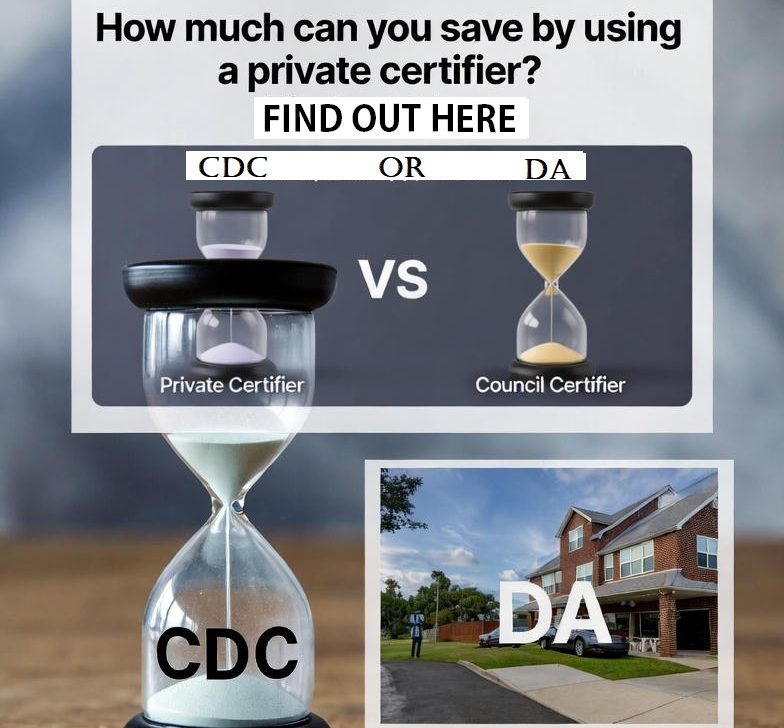
B. Development Application (DA)
Where tree removal forms part of a wider development proposal, such as a new dwelling, extension, subdivision or commercial development, the proposed removal may be assessed as part of the DA.
Council may impose conditions requiring tree retention, replacement planting, protection fencing and arborist supervision.
C. Complying Development Certificate (CDC)
Certain vegetation removal may be permitted as part of complying development under the relevant planning provisions.
However, a CDC does not automatically authorise the removal of every protected tree.
The relevant development standards, exclusions, vegetation controls and approval conditions must be checked before work commences.
D. Native Vegetation Panel Approval
Where proposed clearing is regulated under the Local Land Services Act 2013 and associated native vegetation provisions, approval from the Native Vegetation Panel may be required, depending on the land and clearing circumstances.
E. Exemptions
Certain vegetation work may be exempt from approval under applicable legislation or council controls.
However, property owners should not assume that a tree can be removed simply because it is dead, damaged, dangerous or located within private property.
The applicable exemption must be confirmed before removal.
3. Tree Protection During Construction and Development
Tree protection is particularly important during demolition, excavation, building construction, landscaping and civil works.
Even when a tree is not proposed to be removed, nearby construction activities can damage its roots, trunk, branches and growing environment.
Damage may not become immediately visible. In some cases, a tree may deteriorate or die months or years after construction has been completed.
For this reason, tree protection requirements should be considered during the initial design and planning stages.
Important protection measures include:
-
Establishing the Tree Protection Zone (TPZ).
-
Identifying the Structural Root Zone (SRZ).
-
Installing appropriate tree protection fencing.
-
Providing trunk and branch protection where necessary.
-
Preventing excavation and root damage.
-
Controlling vehicle and machinery access.
-
Preventing soil compaction and changes to ground levels.
-
Keeping building materials and chemicals away from protected areas.
-
Arranging arborist inspections and supervision where required.
These measures should be documented in the project Tree Protection Plan and implemented before construction activities commence.
4. What Is a Tree Protection Zone (TPZ)?
The Tree Protection Zone (TPZ) is the designated area surrounding a tree that must be protected during construction and development.
Its purpose is to maintain the tree’s health, viability and growing environment by protecting the root system and surrounding soil.
The TPZ is determined using the tree’s Diameter at Breast Height (DBH), measured at approximately 1.4 metres above ground level.
TPZ calculation
The standard calculation under AS 4970:2025 is:
TPZ radius = DBH × 12
Where:
-
TPZ = Tree Protection Zone radius.
-
DBH = Diameter at Breast Height, measured in metres.
The general minimum TPZ radius is 2 metres, and the maximum is 15 metres, subject to the standard and arboricultural assessment.
Example of a TPZ calculation
For a tree with a DBH of 500 mm:
500 mm = 0.5 metres
TPZ = 0.5 × 12
TPZ radius = 6 metres
This means that a generally calculated 6-metre radius around the tree should be protected during construction.
What activities are restricted within the TPZ?
Activities that may damage the tree or its root system include:
-
Excavation and trenching.
-
Heavy machinery and vehicle movements.
-
Storage of construction materials.
-
Concrete mixing and cement washout.
-
Soil stockpiling.
-
Changes to existing ground levels.
-
Installation of underground services.
-
Uncontrolled pedestrian and construction access.
-
Soil compaction and chemical contamination.
Any proposed encroachment into the TPZ must be assessed by the project arborist in accordance with the applicable standard.
The TPZ is not simply an exclusion area to be ignored when construction becomes difficult. Any encroachment must be properly justified, assessed and managed.
5. What Is a Structural Root Zone (SRZ)?
The Structural Root Zone (SRZ) is the area around the tree’s trunk that contains the major structural roots responsible for maintaining the tree’s stability.
These roots are critical because they anchor the tree into the ground and help prevent it from falling.
Damage to structural roots can compromise the tree’s stability, even where the tree canopy appears healthy.
The SRZ is particularly important when development involves:
-
Deep excavation.
-
Basement construction.
-
Footings and foundations.
-
Retaining walls.
-
Underground drainage.
-
Sewer and water services.
-
Driveways and access paths.
-
Significant changes to ground levels.
SRZ calculation
The standard calculation is:
SRZ radius = (D × 50)^0.42 × 0.64
Where:
-
SRZ = Structural Root Zone radius in metres.
-
D = Trunk diameter immediately above the root buttress (DAB), measured in metres.
The general minimum SRZ radius is 1.5 metres.
The SRZ calculation is different from the TPZ calculation because it uses the trunk diameter above the root buttress rather than DBH.
Any proposed construction or excavation within the SRZ requires specialist arboricultural assessment.
Structural root damage should never be assumed to be acceptable simply because the tree is outside the building footprint.
6. Difference Between TPZ and SRZ
Both zones are essential for protecting existing trees during development, but they serve different purposes.
| Assessment | TPZ | SRZ |
|---|---|---|
| Full name | Tree Protection Zone | Structural Root Zone |
| Main purpose | Protect tree health and viability | Protect tree stability |
| Primary protection | Root system and growing environment | Major structural roots |
| Measurement | Based on DBH | Based on DAB |
| General calculation | DBH × 12 | (D × 50)^0.42 × 0.64 |
| Minimum radius | Generally 2 m | Generally 1.5 m |
| Typical extent | Larger protection area | Smaller critical root area |
| Construction impact | Controlled encroachment may be assessed | Particularly sensitive to root disturbance |
Why both zones matter
The TPZ protects the broader area necessary for the tree’s continued health and development.
The SRZ protects the critical root area responsible for structural stability.
A construction proposal may be outside the SRZ but still encroach into the TPZ.
This does not automatically mean the construction is acceptable. The overall impact on the tree must be assessed.
7. Tree Protection Fencing and Site Protection Requirements
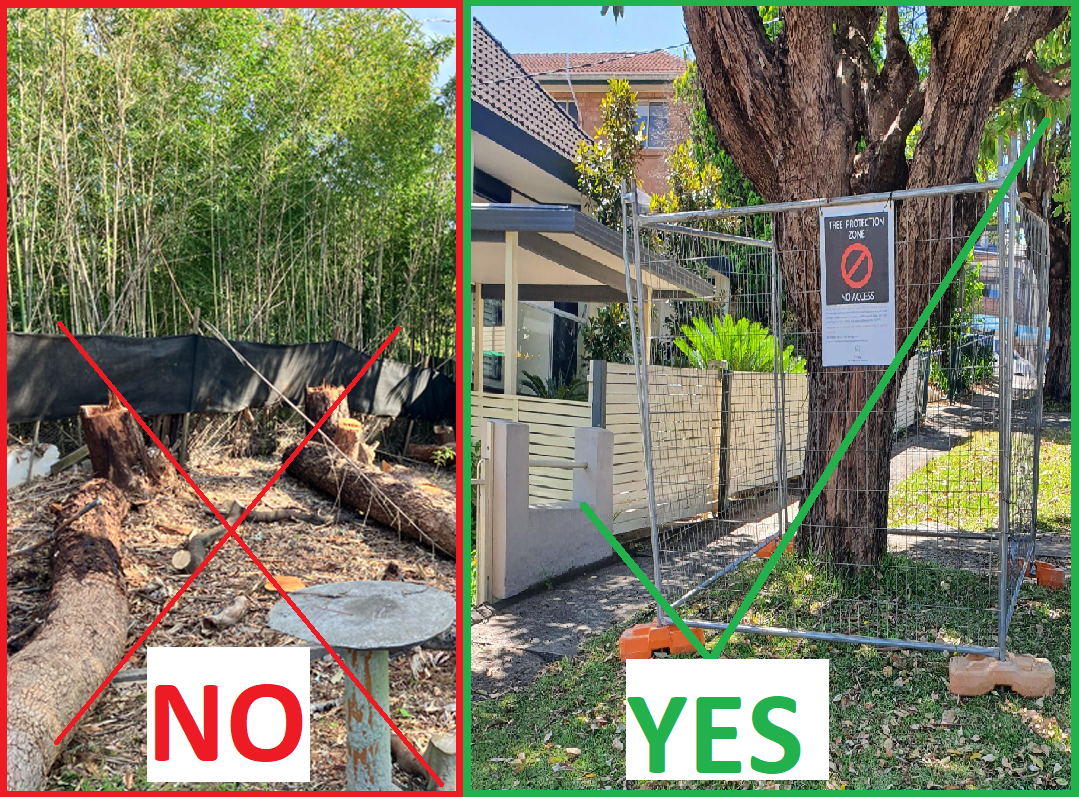
Tree protection fencing is one of the most important practical measures for protecting vegetation during construction.
The fencing should be installed around the designated TPZ before demolition, excavation or construction activities commence.
Depending on the site and arboricultural requirements, the protection system may include:
Tree Protection Fencing
Physical barriers should prevent unauthorised access by construction workers, vehicles and machinery.
Tree Protection Signage
Clearly visible signs should identify the protected tree and communicate restrictions on access and construction activities.
Ground Protection
Where approved access within a TPZ is unavoidable, appropriate ground protection systems may be required to reduce soil compaction and root damage.
Trunk Protection
Suitable protective material may be installed to prevent damage from machinery, scaffolding and construction equipment.
Root Protection
Excavation near tree roots should be avoided wherever practicable. Where unavoidable, appropriate non-destructive investigation and excavation methods may be recommended by the project arborist.
Storage Restrictions
Construction materials, soil, cement, fuel, chemicals and equipment must not be stored within protected areas unless specifically assessed and permitted.
Arborist Supervision
Certain works may require the project arborist to inspect, supervise or certify tree protection measures.
Protection fencing should remain in place throughout the relevant construction period and should not be removed without appropriate authorisation.
8. What Is an Arboricultural Impact Assessment (AIA)?
An Arboricultural Impact Assessment (AIA) is a professional assessment undertaken by a suitably qualified arborist to identify and evaluate the potential impacts of a proposed development on existing trees.
An AIA is particularly important where a development involves:
-
Building extensions close to existing trees.
-
New dwellings and residential subdivisions.
-
Basement excavation.
-
Retaining walls and structural works.
-
Driveways and vehicle access.
-
Underground drainage and utility services.
-
Proposed removal of protected trees.
-
Significant excavation within TPZ or SRZ areas.
An AIA generally considers:
-
Tree species and identification.
-
Tree health and structural condition.
-
Tree dimensions and DBH.
-
TPZ and SRZ calculations.
-
Proposed building and excavation impacts.
-
Potential root damage.
-
Tree retention and removal recommendations.
-
Required tree protection measures.
-
Construction supervision requirements.
The assessment helps councils, designers and development professionals understand whether the proposed works can proceed without unacceptable impacts on protected trees.
9. What Is a Tree Protection Plan (TPP)?
A Tree Protection Plan (TPP) is a project-specific document that identifies how existing trees will be protected during construction.
It generally includes:
-
Existing tree locations.
-
Tree identification numbers.
-
Tree retention and removal schedules.
-
TPZ boundaries.
-
SRZ boundaries.
-
Proposed building footprints.
-
Excavation and construction areas.
-
Tree protection fencing locations.
-
Ground protection measures.
-
Access and storage restrictions.
-
Arborist inspection and supervision requirements.
The TPP should be coordinated with the architectural, structural, civil and landscape drawings.
Where tree protection is a condition of development consent or a construction certificate, the relevant requirements must be incorporated into the construction documentation and followed on site.
10. What Happens If You Remove a Tree Without Approval?
Unauthorised tree removal can result in serious planning and environmental compliance consequences.
Illegal clearing may include:
-
Removing a protected tree without the necessary approval.
-
Poisoning or deliberately killing a protected tree.
-
Ringbarking or otherwise destroying vegetation.
-
Removing substantial tree branches beyond permitted pruning.
-
Damaging protected trees during construction.
-
Removing vegetation in breach of a development consent.
-
Undertaking clearing in an environmentally protected area without authorisation.
Importantly, responsibility may extend beyond the property owner.
Depending on the circumstances, contractors, developers, builders and other parties involved in unauthorised clearing may also face enforcement action.
The fact that a contractor was engaged to remove the tree does not automatically remove the property owner’s or other responsible parties’ obligations.
11. New NSW Tree Removal Penalties – Up to $18,000 for Corporations
One of the significant developments in 2026 is the introduction of stronger penalties for unauthorised vegetation clearing.
The penalty infringement notice structure includes different penalty amounts depending on the offence category and whether the responsible party is an individual or corporation.
Penalty Infringement Notices (PINs)
The relevant published penalty amounts for the applicable offence categories include:
| Penalty category | Individual | Corporation |
|---|---|---|
| Base penalty | $3,000 | $9,000 |
| Higher penalty | $6,000 | $18,000 |
The higher penalty category may apply to prescribed high-value vegetation clearing offences, subject to the applicable statutory criteria.
These may involve larger trees, significant vegetation and other prescribed categories of vegetation.
For example, a corporation responsible for an offence involving qualifying protected vegetation could receive an $18,000 penalty infringement notice.
What is a PIN?
A Penalty Infringement Notice (PIN), commonly referred to as an on-the-spot fine, is issued by an authorised enforcement officer for an alleged offence.
It provides an enforcement mechanism without requiring every matter to proceed directly to court.
However, a PIN is not the only enforcement action that may be taken.
Depending on the circumstances, further investigation, vegetation protection orders, remediation requirements or court proceedings may also follow.
Important: The $18,000 amount is not a universal fine for every unauthorised tree removal. The applicable penalty depends on the offence, vegetation category and responsible party.
12. Additional Enforcement Powers and Court Penalties
Unauthorised tree removal may have consequences beyond an infringement notice.
Depending on the applicable legislation and circumstances, enforcement authorities may use additional powers.
Vegetation Protection and Remediation Orders
Orders may require responsible parties to:
-
Stop further clearing activities.
-
Protect remaining vegetation.
-
Undertake replacement planting.
-
Maintain replacement trees.
-
Restore damaged areas.
-
Remediate affected soil.
-
Obtain specialist arborist assessments.
-
Comply with ongoing vegetation management requirements.
The specific requirements depend on the statutory power used and the circumstances of the offence.
Development Restrictions
Illegal vegetation clearing may also affect future development opportunities.
Where the relevant statutory requirements are satisfied, restrictions may apply to certain complying development pathways for a specified period.
This can affect the way future building or development proposals are assessed.
Property owners should obtain planning advice before assuming that an existing site can proceed through a CDC pathway following unauthorised clearing.
Court Proceedings
Serious unauthorised clearing may also result in prosecution under applicable planning or environmental legislation.
Maximum penalties vary depending on the specific offence and legislation.
Under the Environmental Planning and Assessment Act 1979, certain offences can carry substantial maximum penalties, including penalties for corporations.
These maximum penalties are not automatic fines. The actual outcome depends on the offence, statutory provisions, evidence and circumstances.
Legislative update: The Environmental Planning and Assessment Amendment (Vegetation) Bill 2026 was introduced to Parliament on 21 October 2026. Any proposed additional civil penalty provisions must be distinguished from existing enforceable requirements and should only be described as law once passage and commencement have been confirmed.
13. Are Dead or Dying Trees Exempt from Approval?
Property owners sometimes assume that a dead or dying tree can automatically be removed without council approval.
This is not necessarily correct.
Certain exemptions and approval requirements have changed, and dead or dying vegetation may still be subject to applicable tree protection controls.
The relevant authority may require evidence that the tree meets an exemption or that removal is justified.
In some circumstances, an arborist report may be required to assess:
-
Whether the tree is dead or declining.
-
Whether the tree presents a structural hazard.
-
Whether the tree can be retained through appropriate management.
-
Whether removal is necessary.
-
Whether the proposed removal is covered by an applicable exemption.
Where a tree presents an imminent safety risk, an emergency or safety-related exemption may apply, subject to the applicable statutory requirements.
Property owners should not assume that a tree can be removed immediately without checking the relevant council requirements.
Where possible, obtain written confirmation from the relevant authority before undertaking removal.
14. Tree Removal Approval Process – Step by Step
If you are planning a new development, renovation, demolition or landscaping project, it is important to identify tree protection requirements early.
The following process can help reduce approval complications.
Step 1 – Identify Existing Trees
Undertake a site inspection and identify trees that may be protected under council controls, environmental legislation or heritage requirements.
Step 2 – Review Council Planning Controls
Check the applicable LEP, DCP, tree preservation controls and relevant state planning requirements.
Step 3 – Engage a Qualified Arborist
Where necessary, arrange an arborist assessment to determine the condition, significance
Final Thoughts
Trees are an important part of NSW’s urban environment, and the 2026 regulatory changes demonstrate the Government’s intention to strengthen their protection.
With increased penalty infringement notices of up to $18,000 for corporations, stronger enforcement powers and additional replanting requirements, unauthorised tree removal can have significant financial and development consequences.
The safest approach is to identify protected trees, understand the relevant council requirements and obtain the necessary approval before undertaking any pruning, removal or construction work.
At AUSSURE, we encourage property owners, builders and developers to plan ahead, understand their obligations and address planning compliance issues before commencing work.
Need assistance with your development approval or planning compliance?
Contact AUSSURE to discuss your project and understand the appropriate approval pathway.
Website: https://aussure.net.au/
Email: info@aussure.net.au/
Disclaimer: This article provides general information about NSW planning and tree protection requirements as at October 2026. It does not constitute legal, arboricultural or professional planning advice. Tree removal requirements and exemptions depend on the property, local council controls and applicable legislation. Always confirm current approval requirements with the relevant council or approval authority before undertaking tree-related work.